Showing posts with label Week I: A Voyage to Lilliput. Show all posts

Saturday, May 31, 2014

Chapter 1, Part 7-8 Summary

Part 7

Gulliver prepares to leave for his trip to Blefuscu, but a court official tells him that he has been charged with treason by enemies in the government. Gulliver is charged with public urination, refusing to obey the emperor's orders to seize the remaining Blefuscu ships, aiding enemy ambassadors, and traveling to Blefuscu. In fear of his execution, he swiftly leaves for Blefuscu.

Part 8

Gulliver finds a boat his size which he asks the emperor of Blefuscu to let him fix up. But the emperor of Lilliput also sends an envoy with the articles about Gulliver's eyesight. The emperor of Blefuscu sends it back saying that Gulliver will shortly leave both kingdoms. After a month, the boat is ready and he sets sail off back to England.

Chapter 1, Part 6 Summary

Gulliver goes off to talk about the customs and practices of Lilliput more in detail. The Lilliputian's eyesight are adapted to the size, the animals, trees, and plants, etc. The Lilliputians are very well educated but the writing system seems off to Gulliver. The dead is buried with their heads down, as the Lilliputians believe that the dead will eventually rise on the earth again. Also, the children are not raised by individual parents, but by the kingdom. They are sent from home to live in schools and only see their parents twice a year.

Chapter 1, Parts 4-5 Summary

Part 4

After being freed from his chains, Gulliver goes to Mildendo, the capital city of the Lilliputians. The emperor wants him to see the magnificence of his palace, which is located in the center of the city. After 2 weeks of regaining his freedom, the government official, Reldresal visits him and tells him that two forces are threatening the kingdom. As the war rages on between the two nations, Gulliver is asked for assistance to defend Lilliput against their enemies. Gulliver does not feel that he should intervene but in the end, still offers his help to the emperor.

Part 5

Gulliver goes and spies on the empire of Blefuscu and helps devise a plan. He asks for cables and bars of iron, which he makes hooks with cables attached. He then swims the channel and catches their ships at port. While in Lilliput, Gulliver is greeted as a hero, saving their empire. 3 weeks later, someone from Blefuscu arrives in Lilliput and surrenders.

Chapter 1, Part 2-3 Summary

Part 2

The Lilliputians chain Gulliver to the building in the Capital city where he is finally able to stand up. He gets a view of the countryside and how beautiful it is. Gulliver then goes on about describing this process of relieving himself, which establishes his cleanliness. The emperor visits on horseback from his tower and orders the his servant to give Gulliver food and drink. He and Gulliver strike a conversation but do not seem to understand each other. He saves 6 brigadier who attempted to shoot arrows at him, pleasing the court which led to Gulliver getting his own bed. His belongings are also taken away in a search.

Part 3

As Gulliver hopes to be set free, he is getting along well with the Lilliputians. The emperor entertains him with a rope show and also using 3 silken threads of different colors for this show. Gulliver's hat washed ashore that was discovered by some Lilliputians. Gulliver asks them to bring back his hat but after that, the emperor asked Gulliver to stand tall and pose like a giant. At the end, Gulliver's free but has to first swear to obey the articles put forth. He agrees to these statements and he is freed.

Chapter 1, Part 1 Summary

Lemuel Gulliver, the main character of the story, begins be recounting the story of his life, first, with his family history. Gulliver's father owned a small estate in Nottinghamshire and Guillver is the third of five sons. When he was young, he was sent off to become a surgeon's apprentice because of his families financial problems. When he becomes a surgeon, he boards a ship called Swallow for 3 years and then settles in London and gets married. He then joins another ship called the Antelope, but in the East Indies, the ship is caught out in a violent storm which led to 12 crewmen dying, and 6 crew members left on a small rowboat which soon capsizes. When Gulliver wakes, he finds himself tied and looking up into the bright sun, to see a 6-inch tall human carrying a bow and arrow. The little people start attacking him once he broke lose and waits for a chance to escape. Gulliver is then carried to the capital city, not being able to escape from the little people.

Thursday, May 8, 2014

Lilliputian?

Upon some looking I discovered that the word Lilliputian, though entirely made up by Swift, is now considered a real word.  According to google it means:

adjective
adjective: Lilliputian
1. trivial or very small.

noun
noun: Lilliputian; plural noun: Lilliputians
1. a trivial or very small person or thing.

This is not surprising as they are in fact a very tiny people. What caught me off guard was its "Mentions". After the publication of Gulliver's Travels it seems to have been a very popular word, but use waned quickly around 1960. The Sixties, or the "Cultural Decade" according to Wikipedia, was a time of great change in the United States. Everything from civil-rights to women's rights even to early gay rights pioneers were in question. It would not be surprising if it had fallen out of use as the times changed.

Tuesday, May 6, 2014

Jonathan Swift

Jonathan Swift (1667-1745) was the Irish-born writer of the 1726 Gulliver's Travels. Numerous works produced by him, which include A Modest Proposal, Drapier's Letters, A Tale of a Tub, and An Argument Against Abolishing Christianity, are of satirical nature, which is how he is by far remembered today. In fact, Encyclopaedia Britannica refers to Swift as "the foremost prose satirist in the English language" (Encyclopaedia Britannica). In addition to his satirical works, he also composed many poems, essays, and political pamphlets.

Swift's satirical writing is clearly visible in the first part of Gulliver's Travels. As Swift reveals the thoughts of Gulliver as he observes Lilliputian customs and traditions, he compares the rather savage ways of the Lilliputians to European customs. For example, Swift compares the picky nature on the topic of egg-cracking of the Lilliputians causing war to the petty wars of Swift's time, such as the War of Devolution, the Dutch War, the War of the League of Augsburg, and the War of Spanish Succession. Swift does acknowledge the presence of good law in the Lilliputian society; however, the ill-natured customs seem to take a predominant stance as the face of the island nation.

Swift also belonged to a class of writers known as philosophes, the spearhead figures of the Enlightenment. These writers challenged old European customs and developed new proposals for the "improvement of human condition and the reform of society" (Viault, 157). Other notable figures related to the Enlightenment were Voltaire (another notable satirist in his Candide), John Locke, Baron de Montesquieu, and Jean-Jacques Rousseau. While his Irish roots were not particularly compatible with the English subordination of the time period, Swift incorporated Enlightenment ideals to challenge British supremacy in Ireland.

Interestingly, Swift was plagued with what he described as "fits of vertigo or giddiness," of which is now believed to be Meniere's disease.

Understanding the Character: Gulliver

          Gulliver seems to actually be a benevolent and sympathetic individual. Upon reaching the country of Lilliput and noticing the very small inhabitants, he does not try to control them or destroy them (although he did think about the possibility). Instead, Gulliver does his utmost to hear to the pleas of the nation of Lilliput and address all of its struggles and needs. Gulliver also appears to have a fairly pious moral belief system; he tries to understand and accept the culture of the Lilliputians, despite how foreign it can be and he treats every individual with the respect and safety that they deserve. Overall, Gulliver's educated background certainly helps with amplifying his good personality.

Symbols/Motifs of Section 1

There are quite a bit of subtle, but effective, symbols in the first section of Gulliver's Travels. Here are a few ideas/items that I thought all had a deeper meaning:

#1) The Big-Endians and the Little-Endians: This (quite humorous) struggle has apparently been a major separation for the Lilliputians for a long time. At the time, the Emperor of Lilliput outlawed people breaking their eggs on the big end, but some Lilliputians became angry about this law and fled to the Big-Endian haven of Blefuscu. I find this conflict to be homologous to the differences between religious sects (such as Sunni Islam vs. Shiite Islam and Protestantism and Catholicism).


#2) The Lilliputians being "very foreign" to Gulliver: Gulliver is a mountain compared to the Lilliputians and is clearly superior to them in physical power. He also speaks a language that the Lilliputians don't understand. Lastly, the Lilliputians have strange customs that Gulliver notices when observing their lifestyle. I feel, as a whole, these differences are somewhat symbolic of the imperialistic invasions of the European countries to Africa (Africa being Lilliput and Blefuscu). Gulliver (Europe) lands in Lilliput and has the power to destroy all of Lilliput (Africa), but chooses to "help" them instead, despite the prevalent differences in their cultures.


#3) Gulliver's stomach: I believe that Gulliver's large appetite represents "burden" and "responsibility" for the Lilliputians. They constantly have to feed Gulliver hundreds of their livestock and gallons of their wines in order to satiate his hunger, and this almost gives the Lilliputians a famine. However, Gulliver is a welcomed guest and "hero" for them as so the Lilliputians feel obligated to help him in return.


#4) The chains and ropes holding Gulliver: I find the chains/ropes that hold Gulliver near the palace and on the ground symbolize "power" and "conquest." Despite the minuscule size of the Lilliputians, they were able to restrain and control Gulliver, which shows their dedicated strength and abilities.


#5) Gulliver's ship: The ship that Gulliver uses to conduct his adventures most likely symbolizes "opportunity" and event the " The American Dream." Gulliver went out to sea in search of adventure and possible profit, which accurately describes the mentality of early immigrants to other countries.

Gulliver in the Media

Hmm... How has Gulliver been depicted in the media in illustrations?

(source)

A façade mural of a toy shop in Bremen, Germany:

(source)

From Ray Harryhausen's The 3 Worlds of Gulliver, at the zenith of his filming in the 1960's:

(source)

A more recent film, starring Jack Black:

(source)

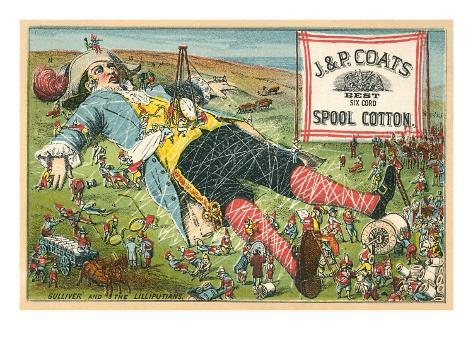
Gulliver has even been used in advertisements! Here is an advertisement for spool:

(source)

Although many of the illustrations associated with Gulliver involve the Lilliputians tying him up, suggesting an evil trait set, Gulliver is also depicted as an altruistic and amiable character, helping the Lilliputians with what would be to them gargantuan tasks.